

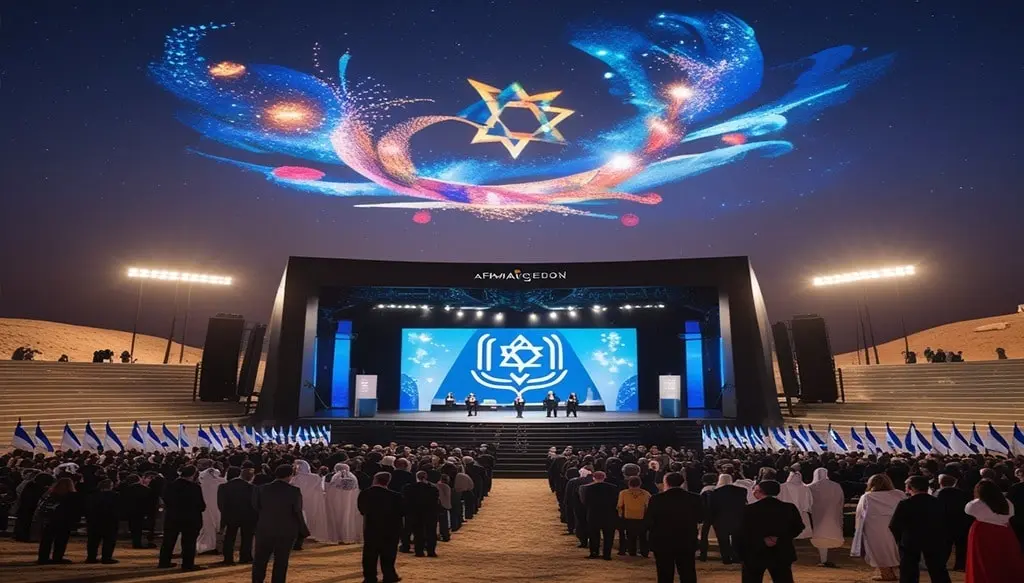
The term Armageddon has emerged as a symbolic representation of a pivotal transformation in modern Israeli identity. In ۲۰۲۵, this landmark event in Israel unified perspectives from politics, technology, culture, defense, and diplomacy into a single convergence. This essay explores seven critical dimensions of the summit, analyzing how it might reshape Israel’s role on the international stage.
This monumental summit has evolved from humble beginnings as an annual gathering of thinkers and creatives. The ۲۰۲۵ edition signaled a clear shift—from a cultural showcase to a strategic platform encompassing high-level diplomacy, military innovation, and digital transformation. Observers noted that the latest version marked a definitive break from tradition and leaned into actionable geopolitics.

Political realignment stood out as one of the most influential elements of the gathering. High-ranking Israeli officials used the stage to launch bold diplomatic overtures, including closer alignment with Gulf nations. The summit hosted critical panels on regional security, generating discussions on new multilateral treaties. The international presence confirmed the forum’s rising relevance beyond Israel’s borders.
National security received prime focus at the event. Israel showcased its newest AI-driven border surveillance systems and upgraded missile defense technologies. Under the theme of “securing the future,” military tech firms presented innovative solutions that underscored Israel’s advanced defense capabilities. Analysts dubbed these initiatives key to establishing Israel’s deterrence through non-combative dominance.
The technological aspect of the ۲۰۲۵ summit was a magnet for investors. The innovation hub attracted over a hundred start-ups across AI, green energy, and biotech sectors. Young entrepreneurs participated in a competitive pitching round, with winners securing funding from global venture capital firms. This part of the gathering was seen as a launchpad for Israel’s next wave of disruptive tech.

Cultural Diplomacy and Soft Power
The cultural programs fostered deeper conversations about identity, co-existence, and storytelling. Art installations, music performances, and literary readings brought Israeli and Palestinian voices to the same stage, encouraging dialogue through artistic expression. This fusion of culture and diplomacy helped position the summit as a model of soft-power engagement.
Economic and Trade Impact
The economic forums drew considerable attention from global investors and trade envoys. Participants highlighted bilateral trade agreements in progress with partners from Asia and Europe. Several post-summit surveys indicated that business leaders viewed the gathering as a high-yield networking space. Some even coined the term “event-driven growth” to describe its economic influence.
Media Strategy and Global Messaging
The media apparatus surrounding the ۲۰۲۵ edition of the event was meticulously orchestrated. A global press center streamed sessions live to dozens of countries. Trending hashtags amplified key messages across platforms. Influencers and policy experts used their social reach to frame Israel as forward-thinking, innovative, and diplomatically agile.
Synthesis: Why It Matters
Bringing together these seven strands reveals how this event functions as more than a traditional conference:
-
Political: It serves as a springboard for diplomatic repositioning.
-
Security: It presents cutting-edge defense strategies.
-
Technology: It drives entrepreneurial ecosystems.
-
Culture: It advocates for co-existence and unity.
-
Economics: It strengthens international commerce.
-
Media: It refines national image-building.
These intersections establish the summit as an anchor point in Israel’s emerging identity, blending hard power and soft influence through a global lens.
Criticism and Controversies
Despite its success, the event was not free from criticism. Detractors argued that combining defense displays with cultural programs diluted the message. Budgetary concerns also arose, with analysts questioning allocation priorities. Palestinian critics labeled some symbolic gestures as superficial, prompting calls for more substantive dialogue and equity in participation.
Looking Forward
The future of this summit appears dynamic. Rumors suggest upcoming editions may take place abroad, rotating through allied nations. There are proposals to create a digital twin version for remote audiences. Others advocate for embedding peace-building explicitly in the event’s core themes. The choices made by Israeli planners in shaping the next chapter will determine whether it remains inclusive or becomes exclusive.
In just a few years, this gathering has grown into a major vehicle for projecting Israeli values, ambitions, and identity. Through integrated programming that spans politics, culture, and commerce, the event encapsulates a new mode of diplomacy rooted in visibility, innovation, and engagement. The name now carries meaning well beyond its origins—becoming synonymous with modern Israeli strategy in action.
Historical and Symbolic Origins
The concept of this summit finds a powerful echo in ancient traditions. The term “Armageddon” comes from the Book of Revelation, where it designates the site of the final battle between divine and evil forces. Derived from the Hebrew “Har Megiddo,” or “Mount of Megiddo,” it refers to an archaeological mound in northern Israel that has seen countless historical battles.
Megiddo’s strategic location made it a focal point for empires such as the Egyptians and Assyrians. Archaeologists have unearthed over ۲۰ layers of past civilizations there. Famous conflicts, like the clash between Pharaoh Necho II and King Josiah in ۶۰۹ BCE, highlight its importance in biblical and political history.
Beyond its literal setting, the place has grown into a metaphor for ultimate struggle. In Christian eschatology, it symbolizes the clash between good and evil in the end times. Many religious and political thinkers still refer to it when discussing modern conflicts in the Middle East.
Modern Significance in Israel
In today’s context, the symbolism behind this ancient term represents more than just spiritual belief. It embodies the fragile balance between security and annihilation in a geopolitically volatile region. For many Israelis, especially those with strong religious ties, the metaphor continues to reflect existential concerns and aspirations for redemption.
Even though policymakers do not refer to it directly, the concept shapes national security thinking. The “Samson Option,” Israel’s theoretical last-resort defense strategy, resonates with the idea of a final confrontation that defines survival.
Culturally, this metaphor surfaces in Israeli media, literature, and art, depicting both national anxiety and resilience. It acts as a mirror to society’s fears and hopes—capturing the tension between historical trauma and future vision.
The summit in question stands as a complex symbol—drawing on rich historical roots, religious meaning, and modern geopolitical urgency. Whether viewed as a site, a story, or a symbol, it underscores Israel’s evolving identity on the world stage. With just one mention, the term “Armageddon” resonates across history, myth, and diplomacy—marking a profound convergence of past and present in the Israeli vision.

The conflict between Israel and Palestine is one of the longest-running and most emotionally charged disputes in modern history. It involves deep-rooted issues related to territory, religion, national identity, and historical trauma. Over the years, military operations by Israel against Palestinian territories—especially in Gaza and the West Bank—have drawn both condemnation and support from different corners of the international community.
These attacks are usually framed by Israel as responses to threats from militant groups like Hamas or Islamic Jihad, which operate from within Palestinian areas. From the Israeli government’s perspective, such actions are about national security and protecting civilians from rocket fire and other violence. Yet, on the Palestinian side, these operations are seen as collective punishment, often resulting in large-scale civilian casualties, destruction of homes, and lasting trauma for entire communities.
Every time such a conflict escalates, media headlines and social media platforms flood with images of bombed-out buildings, children injured in strikes, and entire neighborhoods reduced to rubble. These visuals often stir outrage around the world, especially among human rights groups and pro-Palestinian activists who argue that the military response is disproportionate. Many accuse Israel of violating international laws and humanitarian principles, while Israeli officials point to their right to defend against terrorism and maintain national security.
The humanitarian impact is massive. In Gaza, where over two million people live in a very small area, airstrikes and ground operations have led to the collapse of hospitals, power outages, and water shortages. Civilians—especially women, children, and the elderly—are caught in the middle. The constant threat of violence has created a generation of traumatized people, living with fear and uncertainty.
On the political front, peace negotiations have repeatedly failed. The reasons are complex. Israeli settlements in the West Bank, the status of Jerusalem, the right of return for Palestinian refugees, and the role of militant factions are just some of the major sticking points. Both sides have leaders who face internal pressure and carry the burden of history, making compromise extremely difficult.
In this context, some religious and political thinkers begin to draw connections between the current conflict and ancient prophecies. The word “Armageddon” comes from the Book of Revelation in the New Testament and refers to a final, cataclysmic battle between the forces of good and evil. The original term, “Har Megiddo” or “Mount of Megiddo,” refers to a real place in northern Israel, where many historical battles took place.
Although modern warfare in Israel and Palestine is driven by political and strategic interests, the region’s religious significance causes some to view these events through a prophetic lens. Certain evangelical Christian groups, for example, believe that continued conflict in the Holy Land is a sign of the end times. For them, the struggle between Israelis and Palestinians is not just about borders or politics—it is part of a larger divine drama foretold in sacred texts.
This spiritual framing is not shared by everyone, of course. Many Israelis and Palestinians are secular or view the situation purely in terms of human rights, justice, and security. Still, the myth of an ultimate battle in the Holy Land continues to influence global narratives. When a new wave of violence breaks out, terms like “apocalypse” or “final war” often surface in commentary and social media.
In truth, the real battle is not between good and evil in a cosmic sense, but between two peoples who both feel wronged, both carry historical scars, and both seek recognition and safety. The tragic reality is that each act of violence deepens mistrust and widens the divide. Lasting peace will require not just ceasefires, but deep changes in perception, leadership, and commitment from both sides and the global community.
By understanding the mythological weight carried by this region, we can see how modern events echo ancient fears and hopes. But we must not let prophecy override the human need for justice, compassion, and peace.




Leave a Reply